Many organisations schedule maintenance at fixed intervals. But what if the greatest risks are actually in places not covered by the maintenance calendar? Discover why more and more companies are opting for a risk-based approach to maintenance.
Preventive maintenance is often summarised as: maintaining before an installation fails. That principle is logical, but in practice, it is not enough. Not every component is equally critical, not every defect has the same consequences, and not every installation requires the same maintenance interval.
An effective maintenance strategy therefore does not start with the calendar, but with insight. Which components are essential for the safety, availability, and continuity of the process? Which failure mechanisms can occur? And which form of maintenance suits the risk and the technical condition of the installation?
By organising maintenance on a risk-based footing, work can be planned more effectively and deviations become visible sooner. The result is greater control over installation condition, maintenance priorities, and business continuity.
A fixed maintenance interval may be practical, but it does not automatically take into account the actual condition and criticality of a component.
A hydraulic installation, for example, can consist of:
A defect in a redundant or easily replaceable part may have limited consequences. Conversely, failure of a safety-critical actuator, pump, or valve can affect the availability of an entire installation.
That is why it is wise to determine the following for each installation or system part:
Based on this, a distinction can be made between periodic, condition-based and corrective maintenance.
Preventive maintenance does not mean that every component must be replaced as standard after a fixed period. The right approach depends on the function, condition and consequences of failure.
With periodic maintenance, tasks are carried out according to a predetermined schedule. This can be suitable for components where it is known that wear is related to service life, load, operating hours or a prescribed inspection cycle.
Examples include:
With condition-based maintenance, measurements and inspection results determine when intervention is necessary. Think of oil sampling, pressure measurements, performance measurements and visual inspections.
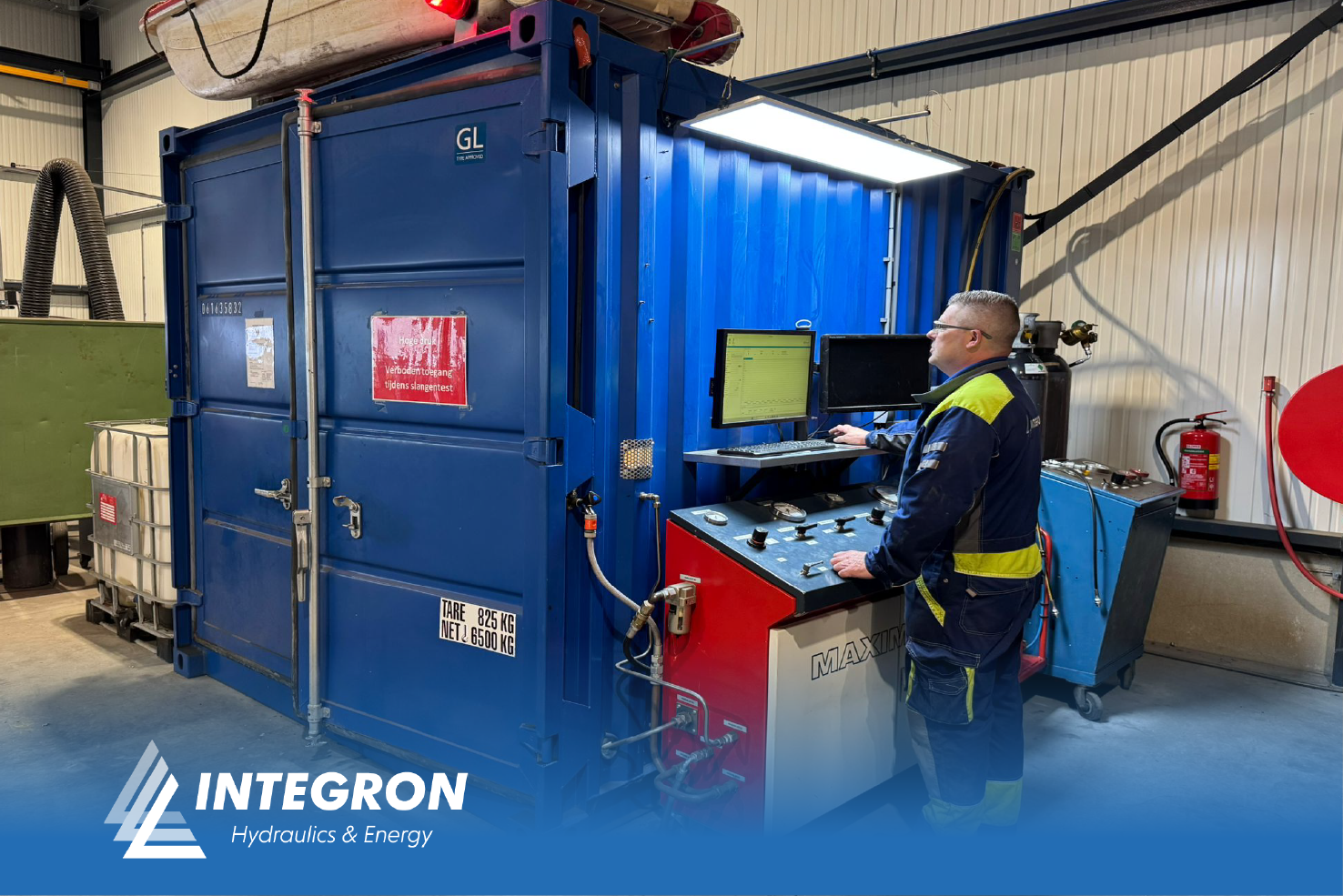
Integron carries out preventive oil sampling, among other things, and uses the results to determine whether filtering or an oil change is appropriate. In addition, hydraulic pumps can be tested on a computer-controlled test bench, after which a test report provides insight into performance and potential follow-up actions.
Corrective maintenance is carried out after a defect or failure has been identified. For some non-critical and easily replaceable parts, this can be a deliberate choice. For components with significant safety or continuity implications, relying solely on reactive maintenance is usually less desirable.
Therefore, a maintenance strategy does not have to be entirely preventive or entirely corrective. A sound approach combines different forms of maintenance based on risk, technical condition, and business importance.
Before a maintenance plan is drawn up, it must be clear which parts are crucial to the process. A criticality assessment helps to rank installations and components based on the consequences of failure.
This can include looking at:
A criticality assessment prevents all components from receiving the same level of attention. This allows people, time, and budget to be deployed where a failure would have the greatest impact.
A maintenance plan is more robust when it is based on technical data rather than just fixed intervals.
Relevant information can include:
By systematically assessing this information, patterns become visible. When a component repeatedly shows the same fault, simple repair may not be enough. In such cases, it is necessary to investigate whether the root cause lies in the sizing, contamination, adjustment, load, installation or control.
In addition to maintenance, Integron also provides engineering, new construction, overhaul and modernisation of hydraulic systems. In certain situations, existing power packs can be redesigned or overhauled, meaning complete replacement is not always necessary.
The condition of hydraulic oil has a direct impact on how a system operates. Contamination can accelerate wear, affect valves and reduce the performance of pumps and other components.
Causes can include:
Oil sampling can help to identify contamination and changes in oil condition. The results must then be translated into an appropriate measure, such as additional filtering, further technical investigation, or oil replacement. The action required depends on the system, the application, and the investigation results.
Maintenance on hydraulic and industrial installations can involve risks. Consider stored energy, high pressure, moving parts, heavy components, potential leaks, and unexpected movements during testing.
That is why safe maintenance begins before any tools are used. Work must be prepared within the procedures and responsibilities of the relevant client and site.
Key points include:
When working on gas, energy, and process installations, the specific regulations of the asset owner are always leading. A general maintenance article cannot replace these site- and installation-specific procedures.
An inspection is only valuable when it is clear what is being checked, how results are assessed, and what follow-up is required.
An inspection of a hydraulic installation can, for example, focus on:
Not every deviation requires immediate replacement. The severity must be assessed in relation to the risk of failure, the function of the component, and the operational conditions.
We view preventive maintenance as a combination of maintenance and inspection. Afterwards, you will receive a maintenance report from us detailing points of interest and, where necessary, a proposal for repairs.
A completed repair does not automatically mean that an installation can be safely put back into operation. After maintenance, it must be verified that the system is functioning as intended.
Depending on the installation and the work carried out, verification may consist of:
At Integron, you can have industrial hoses tested and certified. Following a test, a report or certificate containing technical data and results can be provided. The specific test method, acceptance criteria, and release procedure must always align with the type of installation, relevant requirements, and agreements made with the client.
For asset owners, it is not just important that maintenance has been carried out. Afterwards, it must also be clear what was checked, what deviations were identified, and what measures were taken.
A useful maintenance report should preferably include:
This registration supports technical decision-making and makes it easier to track developments across multiple maintenance intervals.
The question is not just what maintenance costs, but primarily what risk it mitigates. Two cost scenarios can be compared for this purpose.
Preventive maintenance is not automatically cheaper in every situation. The economic value is realised when the cost of a measure is proportionate to the probability of failure and its potential consequences.
That is why a risk-based comparison is more robust than the general assertion that preventive maintenance is always the cheapest option.
A maintenance calendar tells you when work is scheduled. A maintenance strategy also explains why that work is necessary, which risk is being managed, and how the result is verified.
A mature maintenance approach therefore consists of:
In this way, maintenance becomes not just a collection of separate tasks, but a manageable process that aligns with the organisation's technical and operational objectives.
Preventive maintenance is most valuable when it is applied in a targeted manner. The focus is not on the number of maintenance visits, but on whether safety and availability risks are demonstrably managed.
This requires insight into the installation, a critical assessment of failure risks, appropriate inspection and testing methods, and clear maintenance reporting.
Together with your technical team, we can assess the installation condition, criticality, maintenance history, and available test results. Based on this, targeted maintenance priorities and follow-up actions can be established.
Contact us for a technical inventory or maintenance advice.
Integron Aandrijftechniek is a leading technical service provider specialized in hydraulic, pneumatic and electrical systems. With years of experience in drive technology, we offer reliable solutions for maintenance, repair and service to industrial installations throughout the Netherlands.
Groningen
Kieler Bocht 61
NL-9723 JA Groningen
+31 50 316 82 00
Emmen
Phileas Foggstraat 72A
NL-7825 AL Emmen
+31 524 532 797

Visit us on


Leeuwarden
Zwettestraat 27C
NL-8912 AV Leeuwarden
+31 58 288 65 35


